


Before the body positivity movement and plus-size models on the runway, fat people were basically unseen in the world of fashion. Prior to the 2010s, popular film and television rarely featured plus-sized individuals unless the entire storyline revolved around their size. In the 1970s, the ideal body was thin but busty. By the 1980s, it evolved into the “super fit supermodel” look — lean, long, athletic, and toned. These eras weren’t kind to anyone outside the norm, but even then, one woman managed to carve out space for herself in both fashion and Hollywood: Pat Ast.
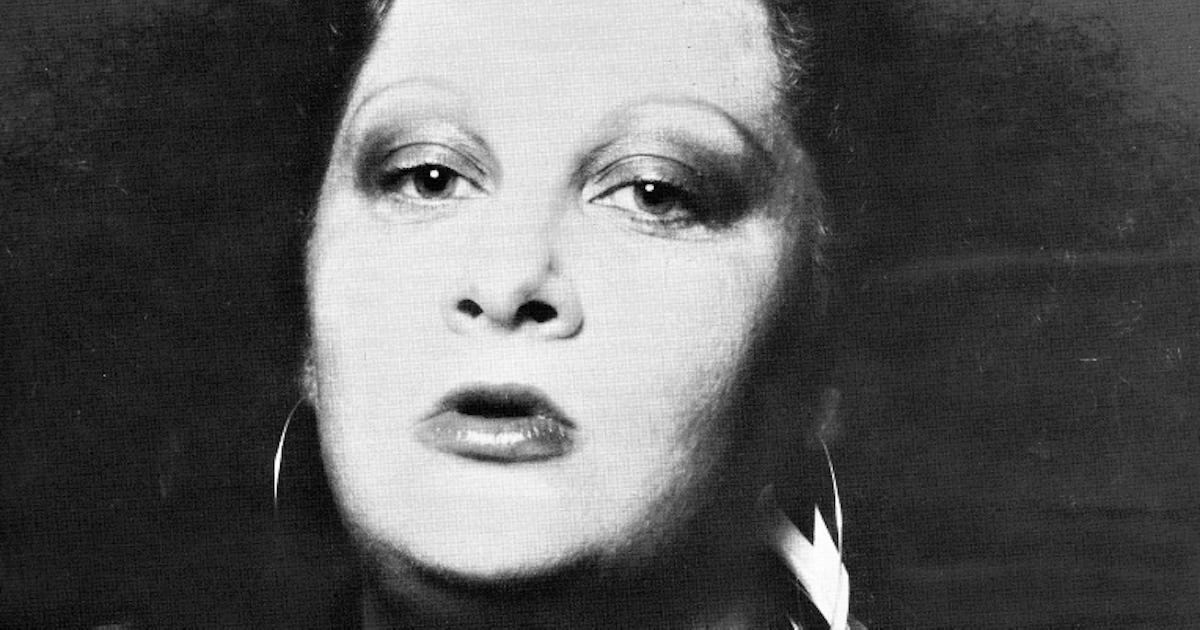
Born in 1941, Pat Ast grew up in Brooklyn’s Flatbush neighborhood. In her twenties, she started spending time on Fire Island — a queer haven that shaped both her social world and her confidence. There, she met director John Schlesinger, who gave her a small part in Midnight Cowboy (1969), her first taste of the silver screen. As her presence in New York’s queer nightlife grew, so did her reputation for being loud, glamorous, and larger than life — a personality that eventually caught the eye of none other than Halston.
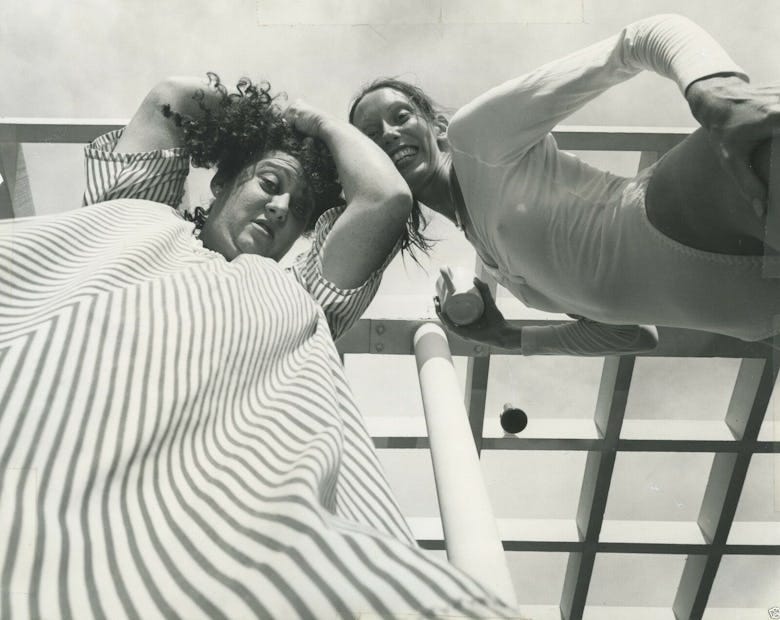
Ast and Halston likely met at Fire Island, possibly through designer Stephen Burrows or interior designer Victor Hugo, both mutuals in that same scene. Her personality instantly stood out to him. And despite her size — which went directly against 1970s fashion ideals — Halston didn’t just accept her; he wanted her in his inner circle.
He offered Pat Ast a job at his Madison Avenue boutique, which she happily left her receptionist gig for. She quickly became part of the Halston mythos: glamorous, campy, warm, and unforgettable. She wasn’t just an employee — she became a symbol of the brand’s spirit. I mean, honestly, who wouldn’t want to be greeted in a luxury boutique by a fabulous, caftan-clad woman with enormous hair and even bigger energy?
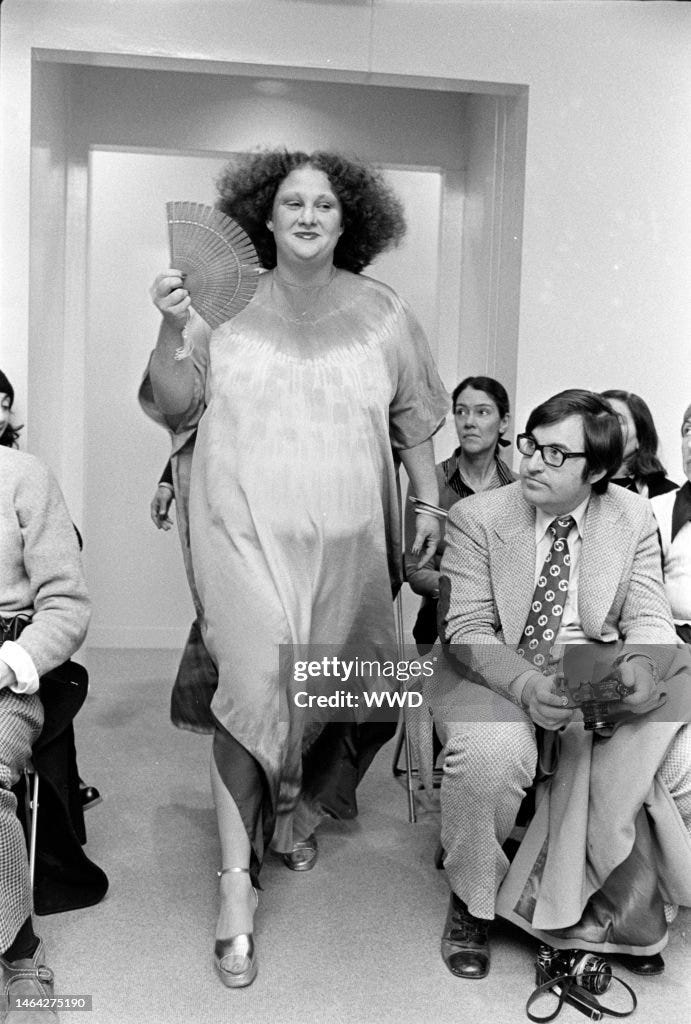
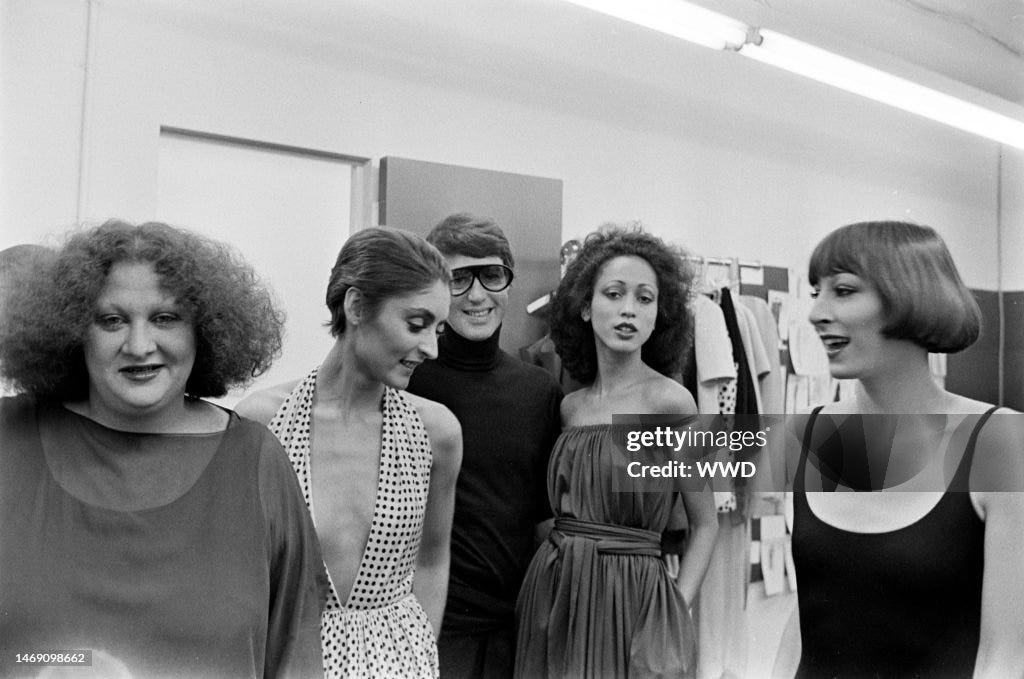
But Ast’s charisma was too big to be confined to a storefront. Halston put her on his runway, welcoming her into the group Andre Leon Talley famously dubbed “The Halstonettes,” alongside icons like Anjelica Huston and Pat Cleveland. Surrounded by women a third of her size, Ast stood out — not just physically, but in presence. She worked the runway. Her Halston visibility led to opportunities with Yves Saint Laurent, but her peak moment came at Halston’s 1972 Coty Awards show, where she literally jumped out of a cake to close the show. Iconic.
That same year, she caught the attention of another It-girl collector: Andy Warhol. She joined the ranks of his “superstars” — Candy Darling, Edie Sedgwick, Nico — when she starred in his 1972 film Heat. Between Halston’s scene and Warhol’s Factory, Pat Ast existed at the center of two of New York’s most influential cultural universes. If that doesn’t cement her status, I don’t know what does.
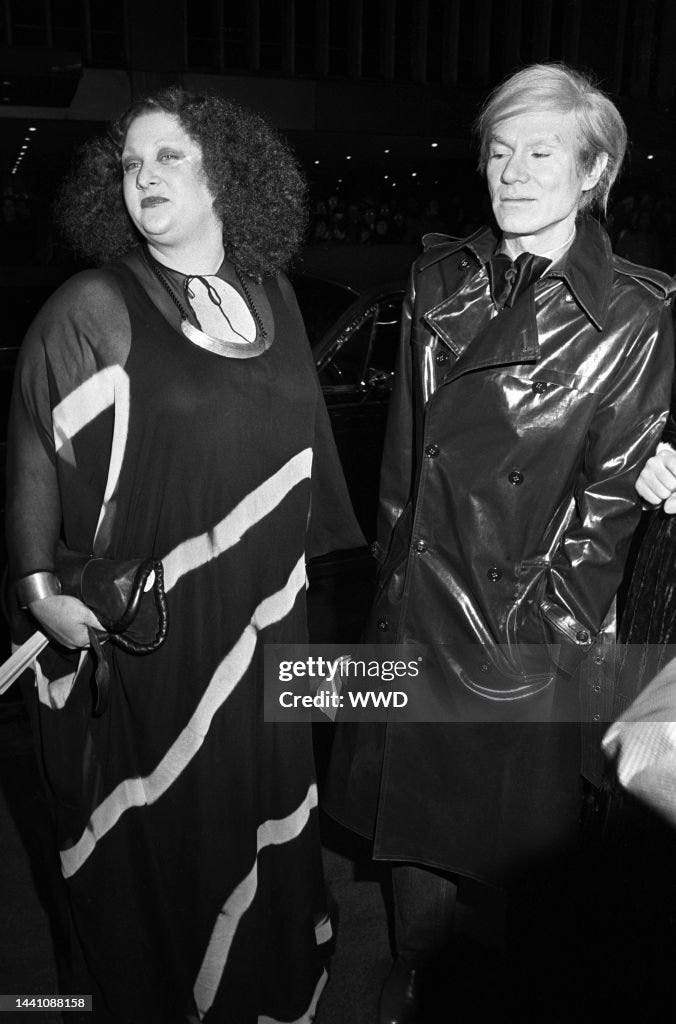
After her success in New York films, Ast moved to Los Angeles to pursue a career in acting. She became known in underground and B-movie circles, appearing in films like The Duchess and the Dirtwater Fox (1976), Foul Play (1978), The Incredible Shrinking Woman (1981), and her cult-favorite role in Reform School Girls (1986). She loved acting — but hated living in LA. Elsa Peretti once told The Times, “We would talk on the phone and she would go on about how much she missed the city and hated ‘that dump.’”

Eventually, she returned to New York and even landed a role in the Broadway production of Nine, though she was dismissed after three months. And after Halston died in 1990, New York never felt the same to her. She adored him — enough to move back to the California she disliked so much. She spent her final years in West Hollywood until her passing in 2001.
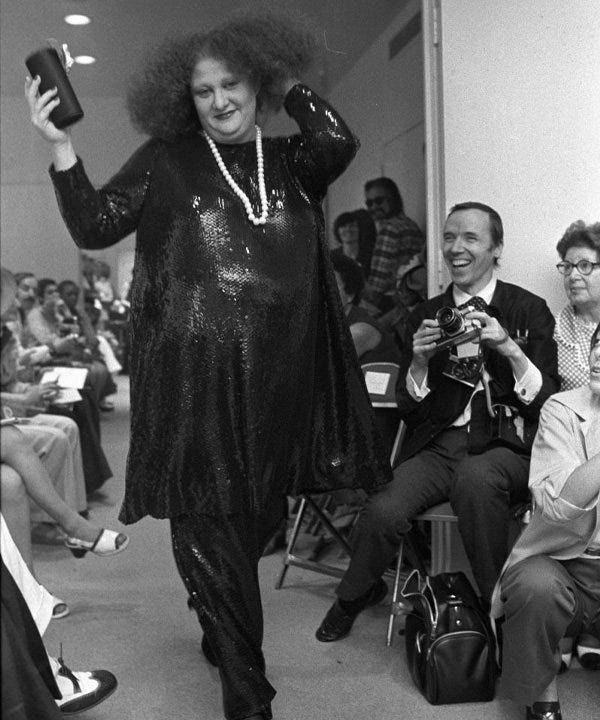
Pat Ast remains one of my favorite It-girls in New York's pop culture history. She’s a testament to excess, glamour, and absolute self-expression. She’s one of the earliest examples of a plus-sized woman embraced not for comic relief or pity, but for her style, her confidence, and her presence. Her legacy is felt everywhere — in today’s body-positive runway moments, in camp aesthetics, in nightlife fashion, and in every oversized caftan worn with zero apologies. Her influence often goes uncredited, but it deserves recognition. She’s proof that less is not always more.