


As if she hasn’t already, Meg Stalter just proved herself to be the fashion goddess I always knew she was.
Alongside her Hacks co-star Paul W. Downs, Stalter was photographed by Vijat Mohindra for the cover of PAPER Magazine’s latest TV issue.
And let me just say: it’s oozing with fashion history.
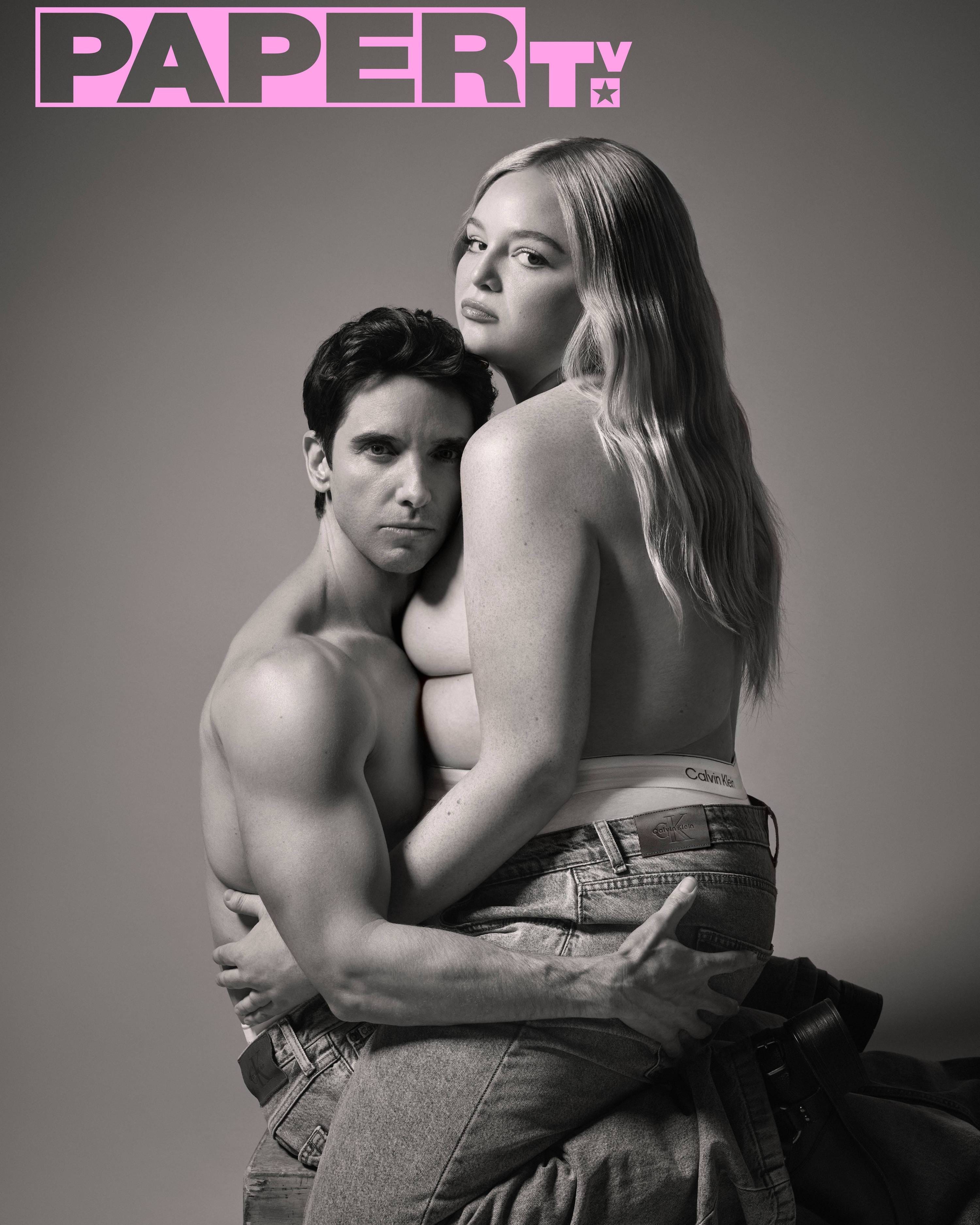
The shoot recreates some of fashion photography’s most iconic visual languages, pulling references from Calvin Klein campaigns, Tom Ford-era Gucci ads, and the work of legendary photographers including Herb Ritts, Richard Avedon, Mario Testino, and Guy Bourdin. But rather than simply paying tribute to fashion history, the editorial is doing something much more interesting. By placing two comedians at the center of some of fashion’s most serious and self-important visual archetypes, PAPER quietly exposes just how performative those images were all along.
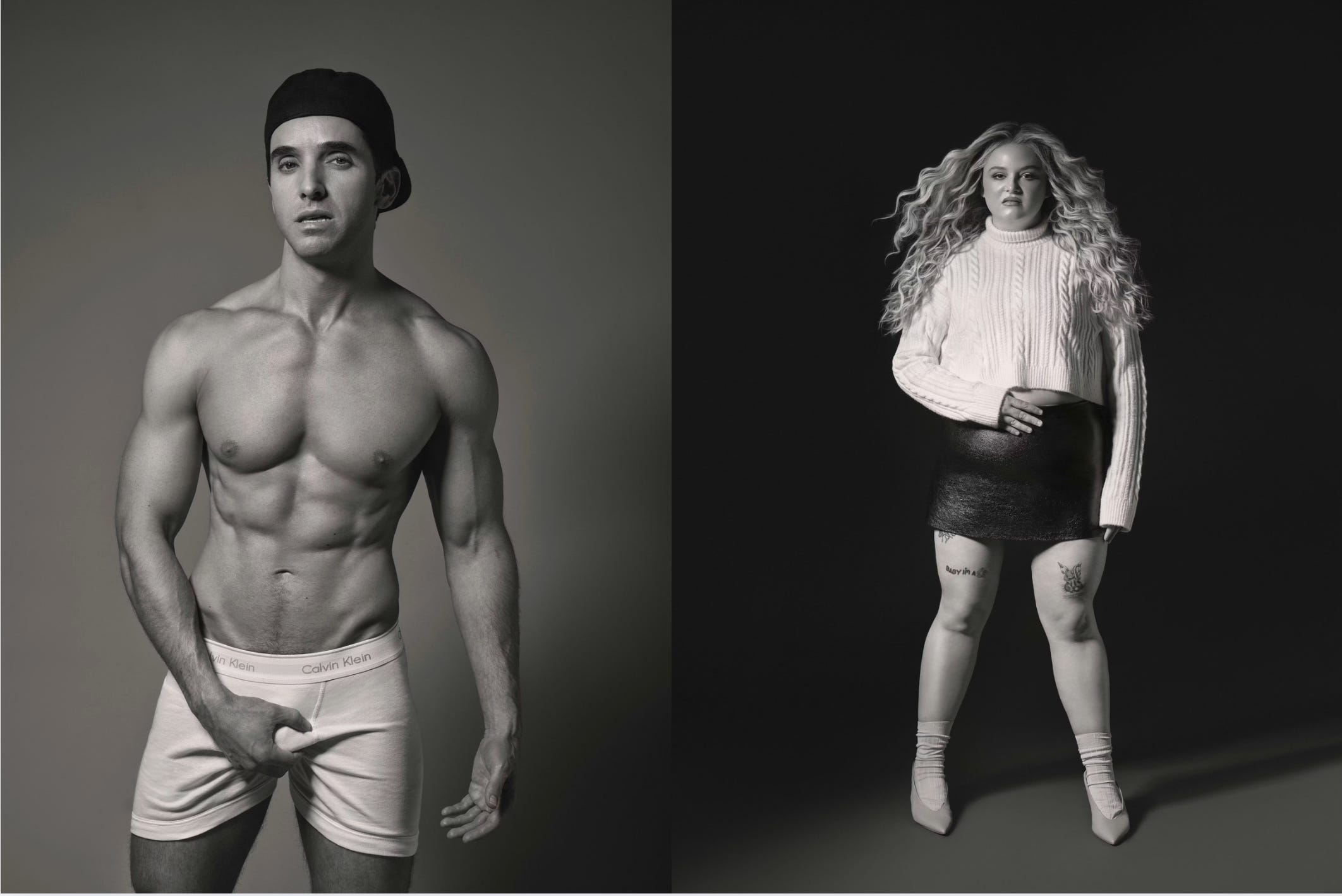
One of the most obvious references appears in a series of black-and-white photographs inspired by Herb Ritts’ iconic 1992 Calvin Klein campaign starring Kate Moss and Mark Wahlberg. Both topless and dressed in low-slung denim, Stalter and Downs recreate the poses almost exactly, right down to the very Moss-ian over-the-shoulder gaze and Downs’ Wahlberg bravado.
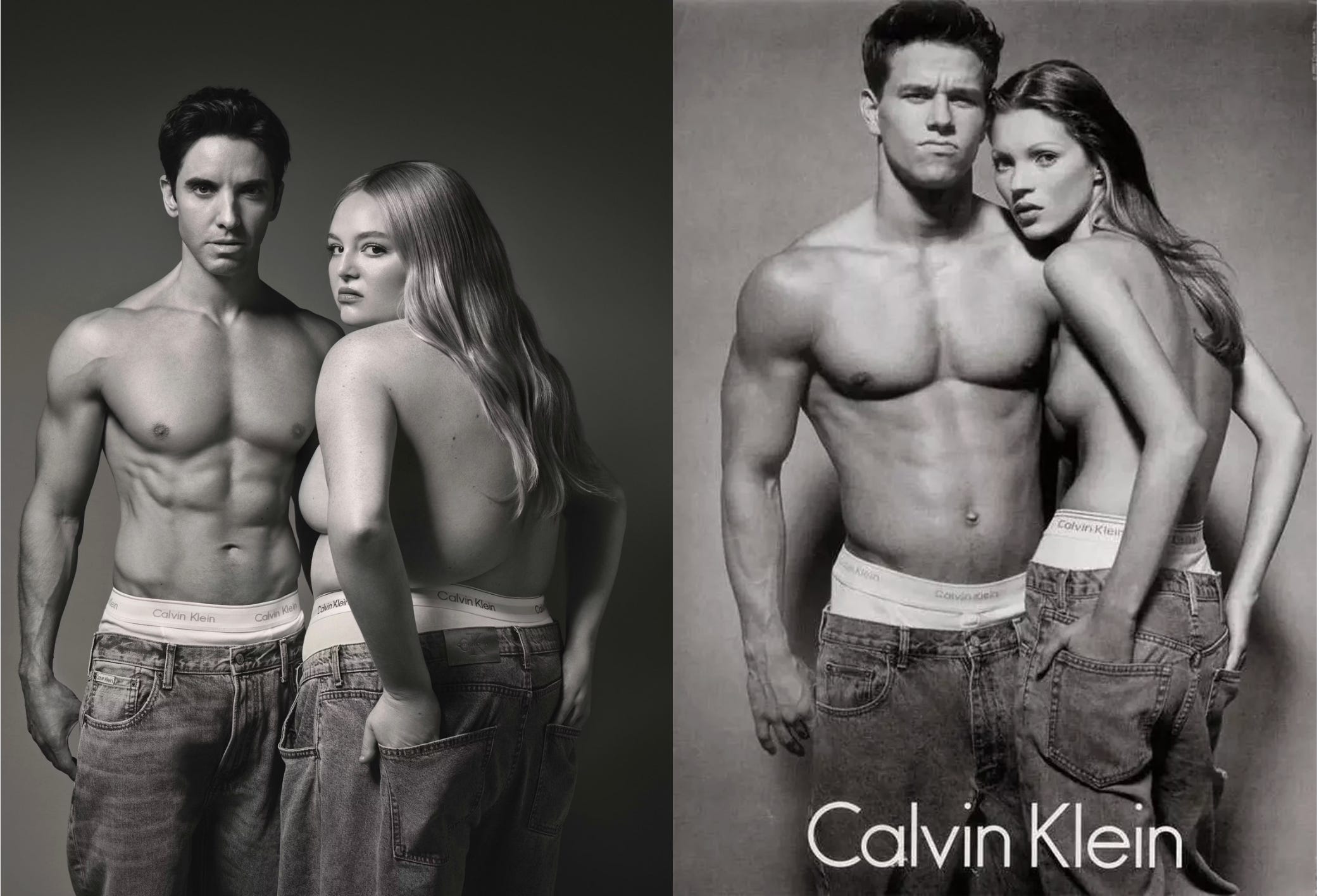
Elsewhere, a photograph of Downs suspended in midair while reaching toward Stalter’s hair references Richard Avedon’s Fall/Winter 1994 Versace campaign featuring Claudia Schiffer and Mark Findley. The recreation mirrors the original’s gravity-defying composition, replacing one of high fashion’s most recognizable images with two actors best known for making audiences laugh – at least, those in the audience who get it.
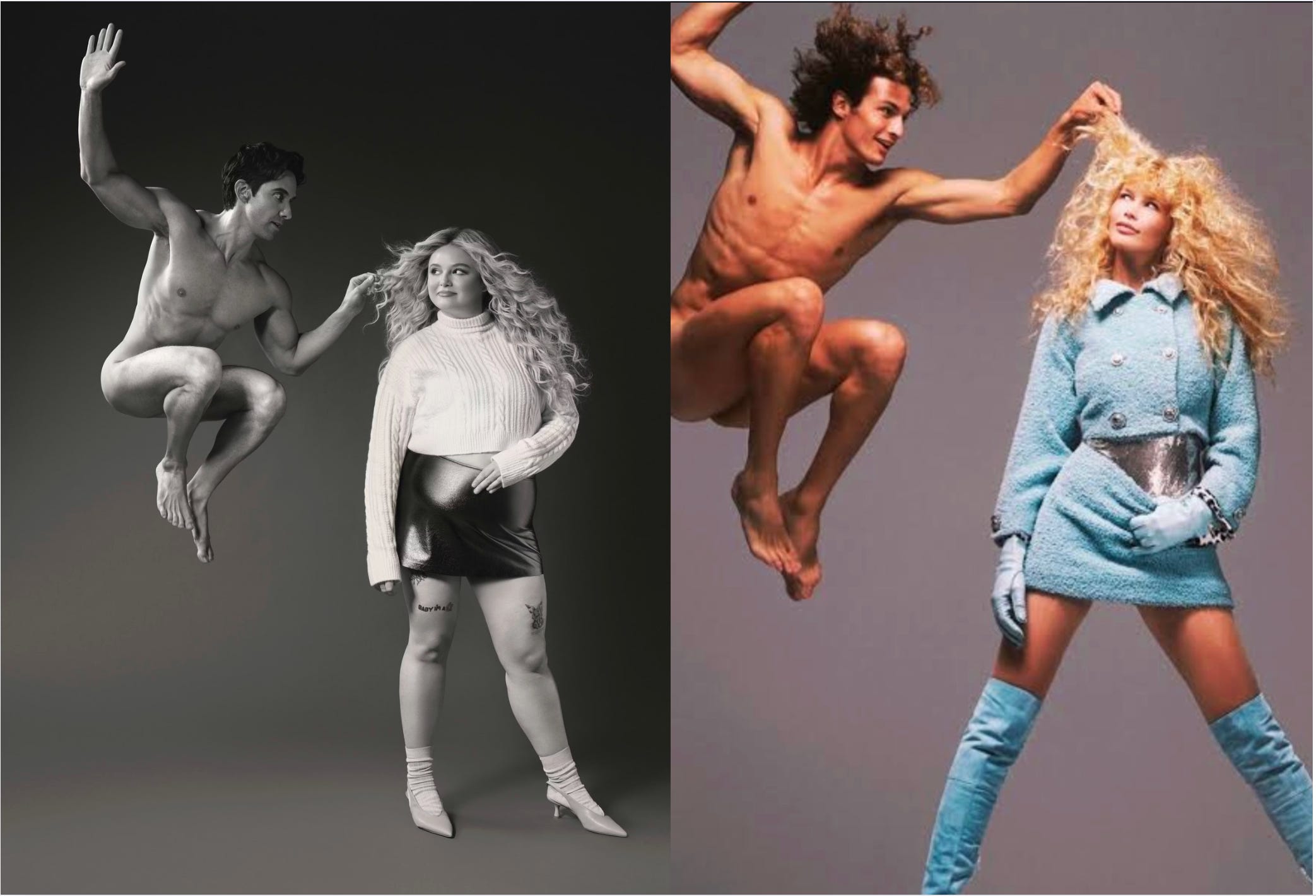
The duo also recreated a famous Mario Testino photograph from Tom Ford’s Gucci era featuring the iconic white cutout dress from Gucci’s Fall/Winter 1996 collection. Wearing a near-identical replica of the dress, complete with its signature gold hip hardware, Stalter steps directly into one of the defining images of 1990s fashion glamour — pout face and all.
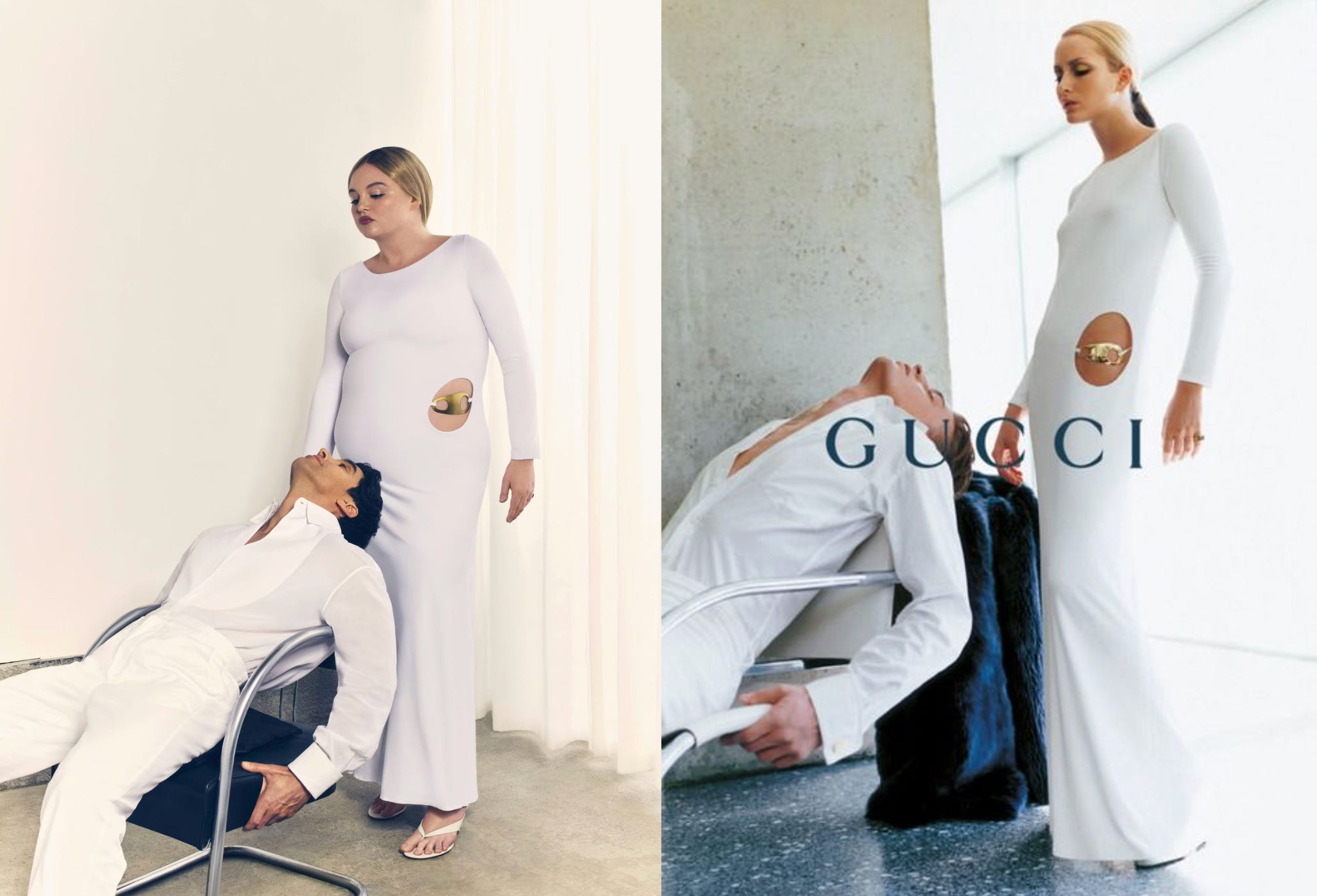
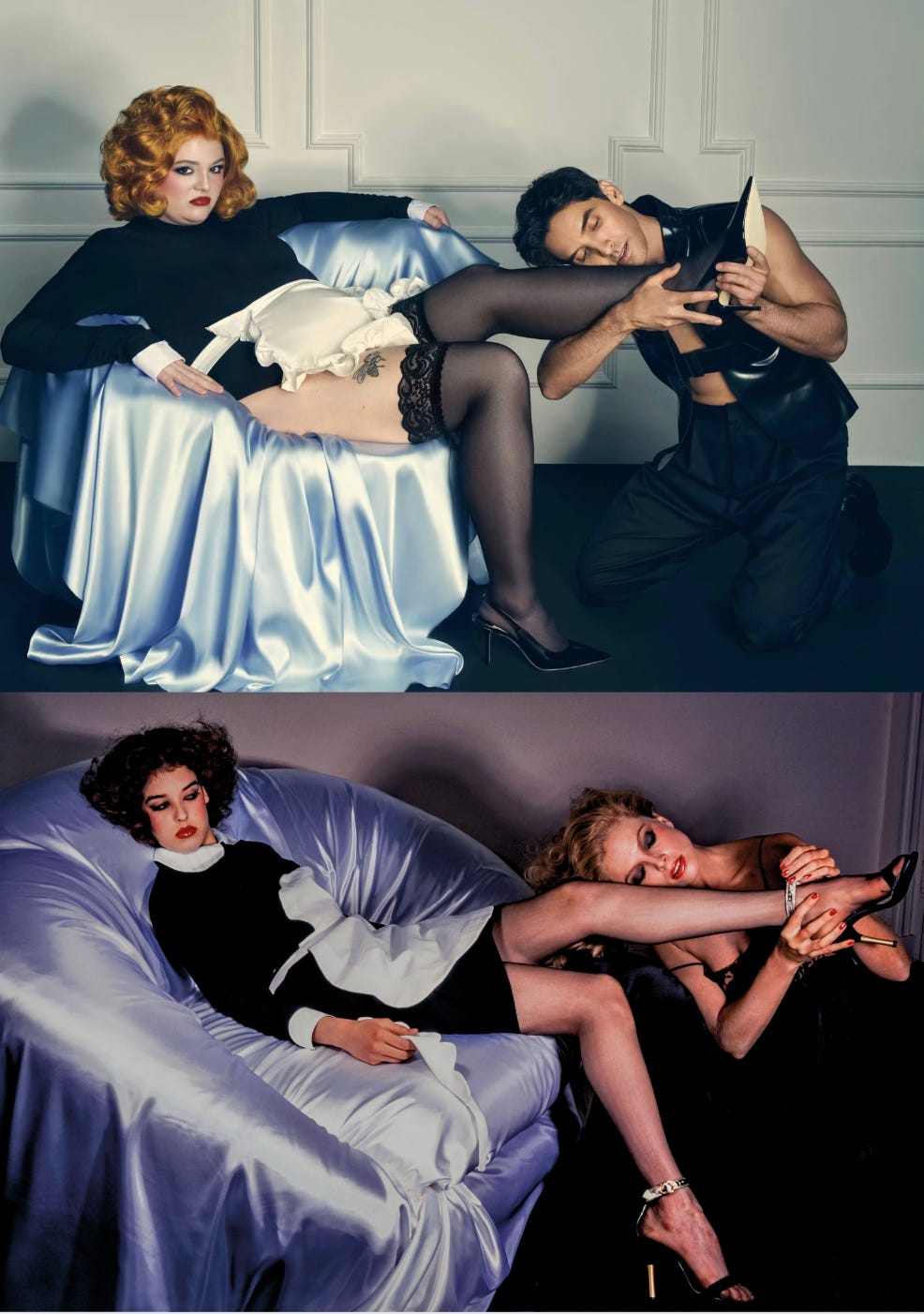
The editorial also pays homage to Guy Bourdin’s Autumn 1977 campaign for Charles Jourdan. In the original image, a woman dressed as a maid reclines on a pale blue satin chair while a woman who appears to be her employer fixates on her elevated leg and stiletto. It’s bizarre, theatrical, vaguely horny, and completely brilliant. Honestly, it might be my favorite reference in the entire shoot.
And Stalter and Downs’ arguably more risqué interpretation may be just as good as the original.
But beneath the Downs crotch-grabbing shots and Stalter’s fashion-forward stank faces, the editorial does something much more complex than simple homage.
By placing two comedians inside some of fashion’s most iconic visual fantasies, the shoot reveals the constructed nature of those fantasies in the first place.
The original campaigns didn’t sell clothes as much as they sold aspiration. Their subjects weren’t people so much as ideals: impossibly cool, impossibly sexy, impossibly effortless. But when Stalter and Downs step into those same poses, the illusion becomes visible. Rather than aspiring to some unattainable ideal, we’re suddenly reminded that sex appeal itself is often a performance.
And when you consider who these cover stars actually are – Meg Stalter, a Lena Dunham muse who recently signed a collaboration with Arby’s, and Paul W. Downs, the co-creator of a show about an old-school Vegas comedy queen and her perpetually unemployed Gen Z writer – that tension between glamour and absurdity becomes the editorial’s greatest strength.
Perhaps that’s precisely why the editorial feels so contemporary. Fashion audiences today are fluent in irony. We can appreciate the beauty of an image while simultaneously recognizing how ridiculous it is. Stalter and Downs aren’t undermining fashion history – they’re participating in it the same way modern fashion thinkers consume it: with equal parts admiration, humor, and self-awareness.
In a cultural moment where celebrities are increasingly rewarded for feeling relatable rather than untouchable, Stalter and Downs are kind of the perfect subjects for a project like this.
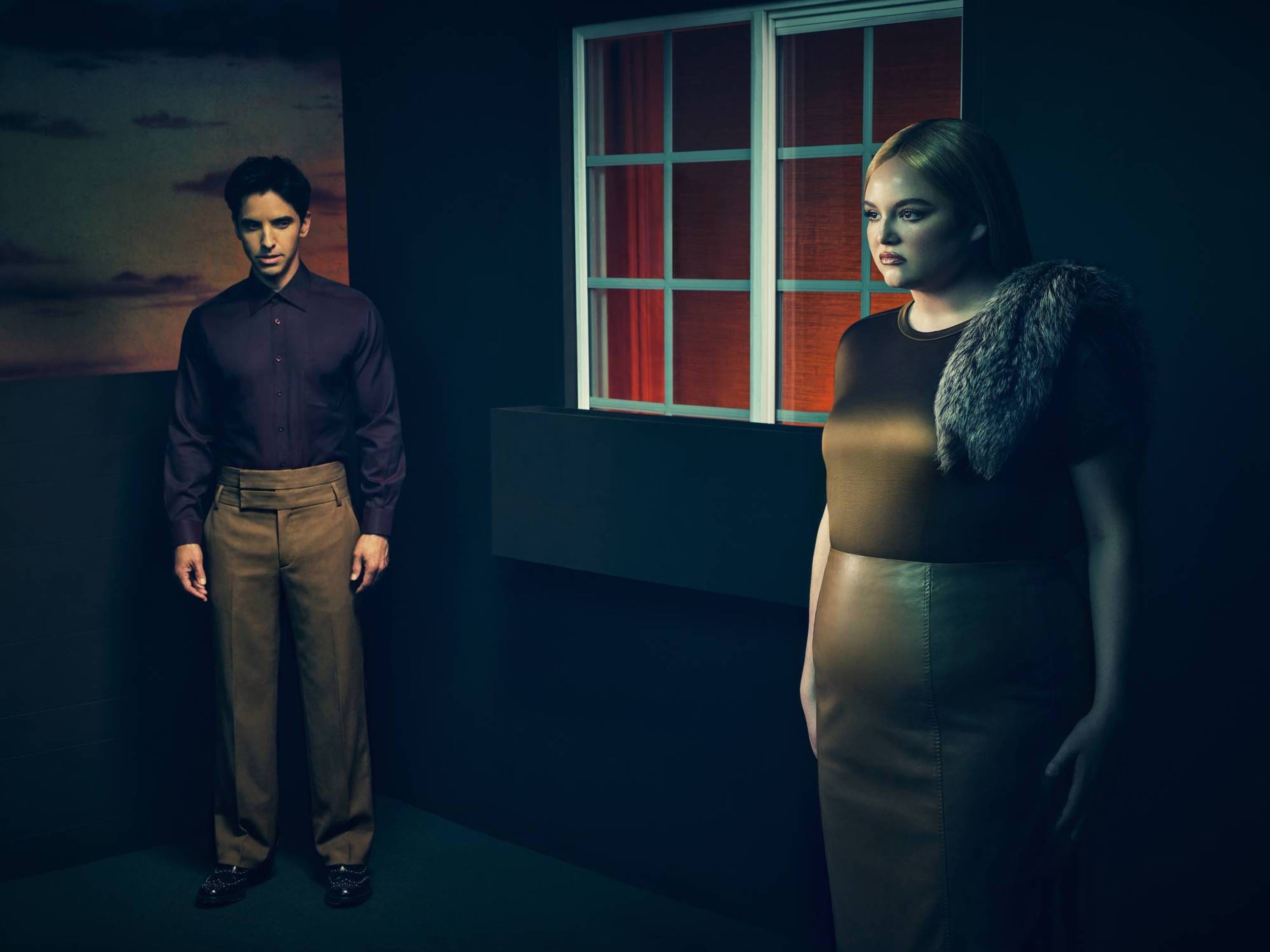
The exaggerated poses and impossible scenarios of the original campaigns were never natural to begin with, and by casting two performers known for comedy, PAPER pulls a complete 180 on decades of fashion mythology and reminds us that fashion has always been a form of acting. Every campaign is a performance. Every model is playing a character. Every photograph is a carefully constructed fantasy.
The result isn’t a parody of fashion photography. If anything, it’s a love letter to it.
Ultimately, the editorial suggests that fashion’s greatest images have always contained an element of theater. By filtering some of the most recognizable visual tropes of the 1980s and 1990s through the lens of comedy, PAPER reminds us that glamour and humor are not opposites.
They’re one and the same.